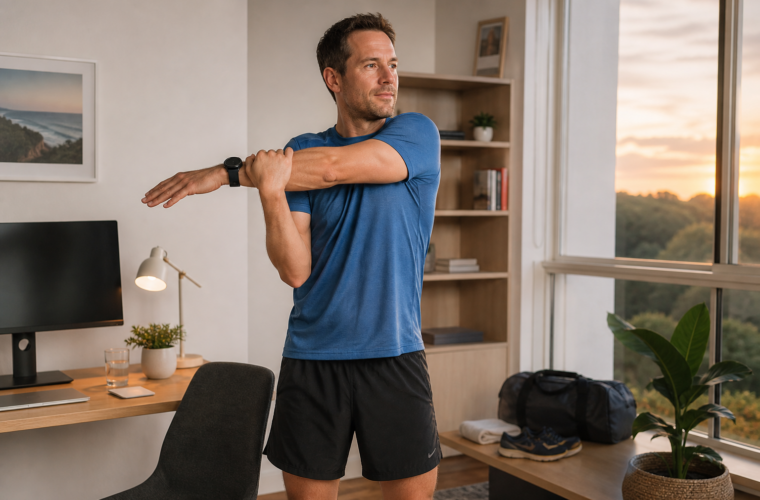

This Pilates stability for runners circuit uses 15 minutes of slow, controlled movement alongside your running week.
Pilates can complement running when it is kept purposeful and low enough in load to fit beside the week’s key sessions. This 15-minute stability circuit uses slow, controlled movements rather than a race to complete repetitions. It is written for recreational runners who already move comfortably on the floor. A mat, a wall and a folded towel are enough.
Choose a day after an easy run or as a stand-alone mobility break, not immediately before a hard workout. The Australian Government movement guidelines support regular activity and muscle-strengthening across the week, but the right amount depends on your current training and health. Keep the range comfortable and breathe continuously.
[adinserter block=”1″]Pilates stability for runners: Two-minute setup
Lie on your back with knees bent and feet grounded. Take five slow breaths, allowing the ribs to widen without forcing the abdomen flat. Roll to one side and stand using your hands if needed. Check that the floor is clear and that you can stop easily. Mild effort is expected; sharp, radiating or escalating pain is a reason to stop.
Four-minute trunk sequence
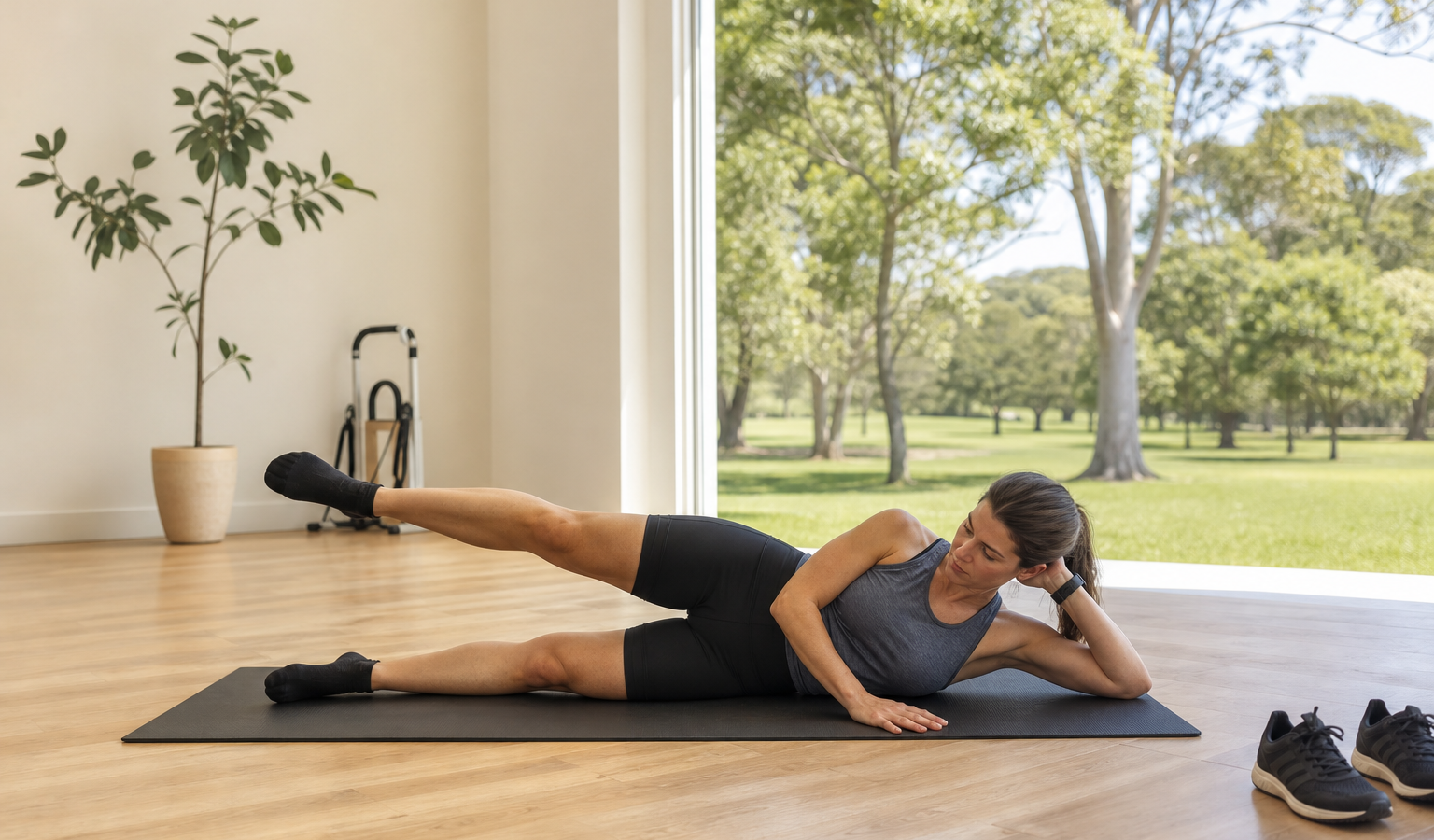
Begin with eight heel taps, alternating legs while keeping the pelvis quiet. If the back arches, make the tap smaller. Move into a bridge for six repetitions: press through both feet, lift only as high as you can control and lower slowly. Finish with a side-lying clam on each side, eight repetitions with the feet together and the top knee opening without rolling the hip backward. Rest whenever breathing becomes held or hurried.
Five-minute hip and shoulder control
Come to hands and knees for six bird-dog reaches per side. Slide one foot back and the opposite hand forward, pause for one breath and return without twisting. Next, kneel beside a wall for a supported hip-flexor shift: tuck the pelvis gently, move forward a few centimetres and return, five times per side. Stand for six wall push-ups, keeping the ribs stacked over the pelvis. The goal is coordination, not maximum depth.
[adinserter block=”1″]Four-minute runner finish
Stand tall and hold the wall for eight slow calf raises. Pause at the top, lower for a count of three and keep the weight even across the forefoot. Follow with six controlled single-leg balances per side, using one fingertip if needed. Finish with ankle rocks and upper-back rotations for one minute. Walk around for a moment before returning to normal training.
Record one useful note: did the circuit leave you steadier, looser or more tired? If it adds fatigue, shorten it to one set and keep it away from your long run. A running watch may display training-load or recovery estimates, but those figures are not diagnoses. Running Watches Australia reviews watch features for runners who want simple ways to compare workload tools.
Fit it into the week
Place the circuit after an easy day, then keep the following session predictable. RunHQ’s training library has scheduling and mobility ideas, and the events calendar helps you work backwards from a race. For technique questions or recurring symptoms, consult an appropriately qualified exercise professional.
Sources
Health and safety notice
This article provides general information only and is not personalised medical, health, nutrition or exercise advice. New or returning runners, pregnant readers, people taking medication, and anyone with a health condition or injury should consult an appropriately qualified health professional or accredited exercise professional before starting or changing training. Stop exercising and seek prompt professional help if you experience chest pain, fainting, severe or unusual breathlessness, sudden weakness, confusion, numbness or any other concerning symptoms.
Featured image: original RunHQ editorial artwork titled “Pilates stability circuit for runners”, with provenance recorded in the media library.
Related reading: Pilates Hip Stability for Runners: A Side-Lying Session.