
Race morning breakfast timing: a practical checklist for planning a familiar meal and keeping your pre-race routine organised.
Race morning is easier when breakfast is a routine rather than a last-minute experiment. The aim is simple: arrive with enough carbohydrate to support the effort, enough fluid to start comfortably hydrated, and a plan that your stomach has already rehearsed. The checklist below is written for Australian runners preparing for a 5K, 10K, half-marathon or marathon. It is educational guidance, not a personalised nutrition prescription.
race morning breakfast timing: Start with the clock, not the menu
Work backwards from the start time. Many runners feel comfortable eating a familiar breakfast about two to three hours before a longer race, while a small top-up closer to the start may suit people who wake with little appetite. The exact interval depends on your digestion, nerves, distance and travel. Write down the start time, your wake-up time and the last moment you can eat without rushing. That turns breakfast into a repeatable part of race logistics.
Choose familiar carbohydrate
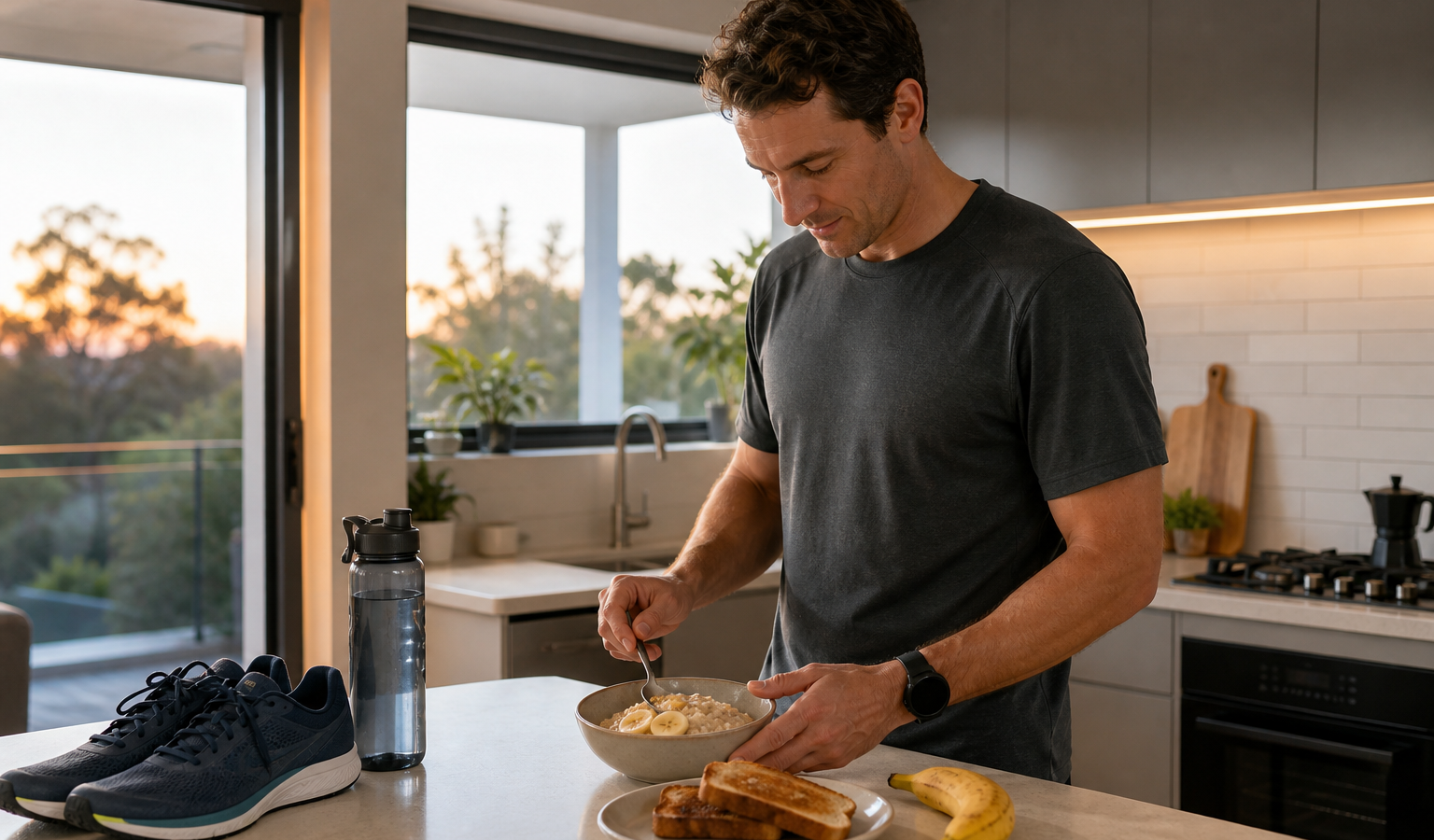
Carbohydrate is the most practical fuel to prioritise before a sustained run. Options might include toast with honey or jam, a plain cereal with milk, oats, a banana, or a rice-based breakfast you have already tested. Keep the portion familiar and moderate. A race morning is not the moment to add a new supplement, a large serve of fibre, or a rich meal that you have never tried before. Sports Dietitians Australia recommends practising competition nutrition in training so you can learn what your own gut tolerates.
For a shorter 5K, some runners prefer a smaller snack; for a half-marathon or marathon, the main breakfast may need to be more substantial. This is not a challenge to eat as much as possible. It is a prompt to match the amount to your event, your usual training pattern and the time available for digestion.
Keep protein and fat sensible
A little protein can make a breakfast feel satisfying, but very large protein serves are rarely needed immediately before a hard effort. Likewise, high-fat foods and heavy pastries can sit in the stomach for some runners. If you enjoy yoghurt, milk, eggs or nut butter, rehearse the combination on an ordinary long-run morning first. The Australian Institute of Sport nutrition resources emphasise individualising food choices and practising them before competition.
Hydrate steadily
Start drinking when you wake rather than trying to catch up with a large bottle at the start line. Sip a familiar amount with breakfast and use the event information to understand aid-station access. Urine colour, thirst, weather and your own sweat pattern all provide context, but none is a reason to force fluids. In warm Australian conditions, plan where you will drink and how you will carry any fluids, then practise the same approach in training.
Use a tested top-up
If there is a long gap between breakfast and the start, a small carbohydrate top-up can be useful: a banana, a slice of toast, a gel you have already tolerated, or a few mouthfuls of sports drink. Keep the quantity and timing familiar. Do not stack several products because nerves make you worry that breakfast was too small. A calm, tested top-up is more useful than a last-minute search for the perfect formula.
Pack a no-surprises backup
Travel, queues and early starts can disrupt even the best plan. Pack the breakfast you have rehearsed, plus a backup snack and a bottle. Check the event website for transport, bag-drop and start-area details the day before. If you are travelling interstate, buy shelf-stable options before leaving home rather than relying on an unfamiliar café menu. This is also a good time to lay out your race shoes, bib, timing chip and any required medication.
Rehearse the whole sequence
Test breakfast timing during a long run or a controlled workout. Note the wake-up time, foods, portion, fluid, bathroom stops and how the first kilometres felt. Keep a short log and change one variable at a time. Rehearsal lets you discover whether you prefer two hours, three hours or a smaller split breakfast without pressure from a race clock.
For further Australian guidance, see Australian Institute of Sport nutrition resources and Sports Dietitians Australia. For practical GPS and training-watch comparisons, visit runningwatches.com.au. You can also keep building a gradual distance base with RunHQ’s progressive 10K ladder.
Race-morning checklist
- Confirm the start time and work backwards to breakfast.
- Pack familiar carbohydrate, a tested top-up and a bottle.
- Use only foods and products rehearsed in training.
- Plan transport, toilets, warm-up and aid stations.
- Record what worked so the next race is calmer.
General information notice: This article is provided for general information and educational purposes only. It is not medical, dietary or individual training advice, and it does not replace assessment or guidance from a qualified health professional or accredited sports dietitian. If you have a medical condition, take medication, are pregnant, have a history of disordered eating, or are unsure how nutrition advice applies to you, seek personalised advice before changing your eating or drinking plan.
Related reading: Seven-Day Post-Race Recovery Reset for Australian Runners.