
Bridge to Brisbane 2026 results show Callum Davies at the head of the 10km male table in 29:15, while Alexandra Lyndon leads the female 10km table in 33:07. The timing page also records the leading 5km and 10km Wheelie finishers. The mass-participation event ran in Brisbane on Sunday 13 September; its organiser had announced more than 40,000 entries before race day, a figure that should not be mistaken for a finisher count.
The leaderboard below is drawn from MultiSport Australia’s event results. Times are shown as the timing page labels them: gun time. This report selects the top three shown in the overall male and female tables for the 10km and 5km, plus the visible Wheelie podiums. It does not treat a split or a separate sponsor segment as a full-race result.
Bridge to Brisbane 2026 results: Bridge to Brisbane 10km results
Davies was 18 seconds ahead of Lachlan Moore, whose 29:33 placed second; Jordan Skelly was third in 29:49. In the female table, Lyndon finished 26 seconds before Richelle Hill (33:33), while Tyla Lumley followed in 34:25. The table records those positions and times, rather than making a claim about course records or athletes’ nationality.
| Place | Male overall | Gun time | Female overall | Gun time |
|---|---|---|---|---|
| 1 | Callum Davies | 29:15 | Alexandra Lyndon | 33:07 |
| 2 | Lachlan Moore | 29:33 | Richelle Hill | 33:33 |
| 3 | Jordan Skelly | 29:49 | Tyla Lumley | 34:25 |
Blue Run 5km results
The 5km male top three were separated by ten seconds from first to third: Padraig Heffernan recorded 14:06, Zac Moore 14:14 and Kaiyan Blue 14:16. Brielle Erbacher led the female table in 16:38, followed by Sayla Donnelley in 17:11 and Alana Hewish in 18:04. These are the first three displayed in each overall table; the official timing site holds the fuller classifications.
| Place | Male overall | Gun time | Female overall | Gun time |
|---|---|---|---|---|
| 1 | Padraig Heffernan | 14:06 | Brielle Erbacher | 16:38 |
| 2 | Zac Moore | 14:14 | Sayla Donnelley | 17:11 |
| 3 | Kaiyan Blue | 14:16 | Alana Hewish | 18:04 |
Wheelie category
MultiSport’s separate 10km Wheelie table lists Tristan Orchard first in 28:09, Geoff Trappett second in 34:17 and Antoine Sandoz third in 52:38. The female Wheelie table displays two finishers in its leading positions: Sara-Ashlee Tait in 38:08 and Rebekkah Law in 1:07:09. We reproduce the entries shown rather than assuming a full field size from the podium view.
Those tables should be read within their own event categories. The Wheelie label is the organiser’s published division name, and the official timing page is the source for category, placing and time. Readers can open the source directly to inspect the additional age, gender and individual result views.
A large community event, with entries kept distinct from finishers
The official event announcement said the 2026 edition sold out with more than 40,000 entries across the La Roche-Posay 10km and Blue Run 5km. That is a pre-event entry figure, not evidence that every entrant started or finished. The Brisbane City Council event listing describes the race as celebrating its 30th year and outlines two routes: the 10km begins near the southern end of the Gateway Bridge at Murarrie, while the 5km starts at Hercules Park; both finish at the Brisbane Showgrounds. Keeping entries, starters and finishers distinct matters whenever a field-size number is reported.
Bridge to Brisbane’s format brings runners, walkers and wheelers onto closed city roads, then funnels both distances toward a shared finish precinct. That broad participation context sits alongside the faster times above: the event’s official tables include separate race and Wheelie categories, while the race-day atmosphere is not captured by the podium rows alone. The results page is the appropriate reference for exact placings; the organiser’s announcement is the source for the sold-out entry number.
How to use the timing information
A gun time measures from the starter’s signal, so it can differ from a net or chip time for someone who crosses the start line later. The official page currently labels its overview tables as “Gun Time”; athletes checking a personal result should open their own individual record and use the organiser’s final classification. The board can also change if officials amend a result, so readers should return to the timing provider for the latest status rather than relying on a copied table alone.
For recreational runners, a fast result is context, not a prescription for the next training week. Recovery, prior preparation and the effort of the day vary from person to person. RunHQ’s progressive 10K plan offers a gradual distance-building example for those considering a future race, while the sibling Running Watches Australia comparison explains how GPS watches can support pace awareness. A watch is not the official timing record; the event’s result system is.
Sources
- MultiSport Australia: 2026 Bridge to Brisbane official timing results
- Bridge to Brisbane: sell-out announcement and entry count
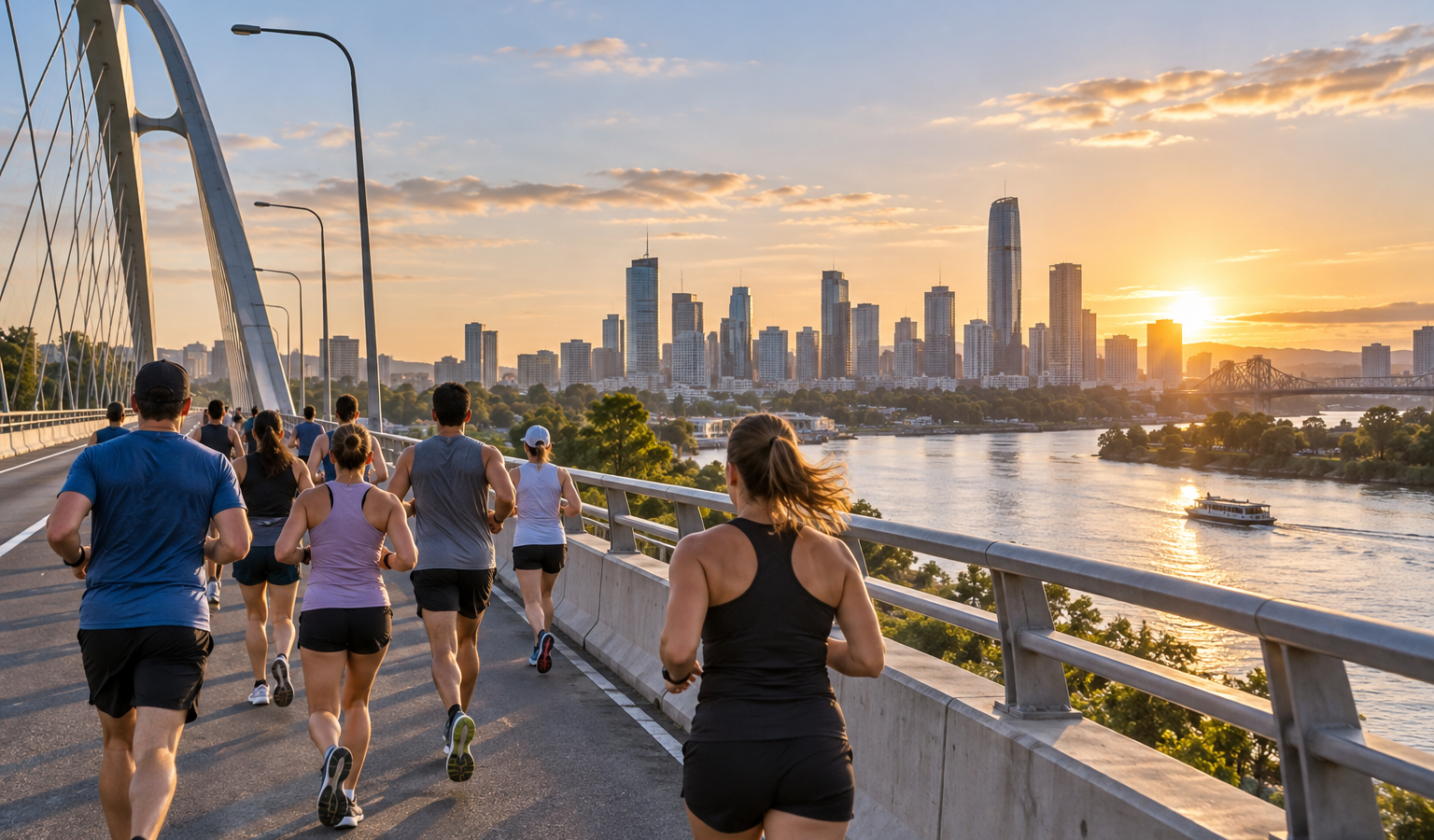
Image credit and provenance: Original AI-assisted RunHQ illustration generated for this report on 14 September 2026. It depicts anonymous runners on a generic river bridge at dawn; it is illustrative artwork, not a photograph of Bridge to Brisbane, its course, or actual participants.