

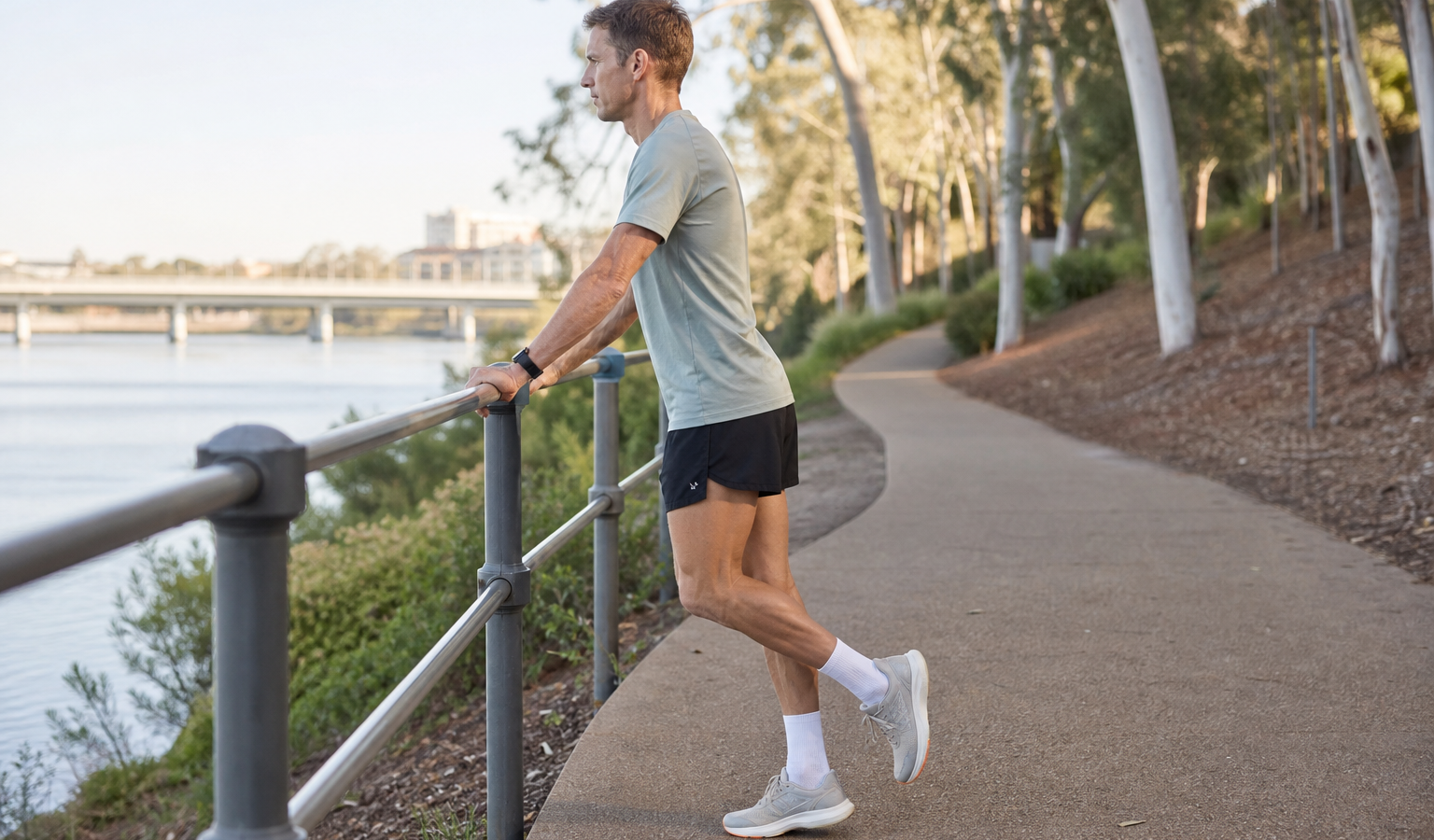
Calf strength for runners: a progressive four-week plan with controlled exercise, load guidance and space to adjust the progression.
Calf strength helps runners manage the repeated demands of landing, supporting and pushing off. A useful plan does not begin with hundreds of repetitions; it starts with a version you can control and progresses one variable at a time. This four-week framework suits runners who are already training consistently and want a simple addition to an easy-day routine.
calf strength for runners: Why train the calf complex?
The calf muscles work across the ankle during every stride. Straight-knee and bent-knee raises provide slightly different emphases, while supported single-leg work adds balance and side-to-side control. Strength training cannot guarantee injury prevention, and pain should never be treated as a challenge to push through.
Review training-load and recovery features at Running Watches Australia.
Week 1: establish technique
Twice this week, perform two sets of 10–12 two-leg calf raises with fingertips on a wall or rail. Rise smoothly, pause briefly and lower under control. Add two sets of eight bent-knee raises, keeping the heels aligned. Stop well before form becomes hurried.
Week 2: shift the load
Continue twice weekly. Rise with both feet, transfer more weight to one side, then lower slowly on that leg. Complete two sets of six to eight each side. Keep the movement comfortable and use support. Finish with two sets of ten bent-knee raises.
Week 3: supported single-leg work
If week two was well tolerated, try two or three sets of six to ten supported single-leg raises. Use a full comfortable range without bouncing. Keep the pelvis level and avoid gripping the support. If one side cannot complete the movement cleanly, return to the assisted lowering version.
Keep hydration convenient around strength and running sessions with reusable bottles from Mizu Australia.
Week 4: consolidate before adding load
Repeat week three or add only one progression: one or two repetitions, a third set, or a light backpack. Do not increase all variables together. This consolidation week helps determine whether the current level is repeatable.
Where it fits
Place calf work after an easy run or on a separate strength day, not immediately before intervals or a long run. RunHQ’s flexible schedule guide can help space demanding sessions, and the single-leg strength session provides complementary hip and trunk exercises.
Begin with once weekly if strength training is new. Mild muscle fatigue may be expected, but sharp pain, swelling, altered gait or worsening symptoms are reasons to stop and seek advice.
Progress without chasing soreness
Use controlled movement and leave several good repetitions in reserve. Delayed soreness is not proof of an effective session. Consistent practice matters more than exhausting the calves, especially while running volume is rising.
Footwear and surface
Choose a stable, non-slip surface and supportive footwear if that feels safest. Barefoot work is not required. Grip socks from TAVI Active or ToeSox may suit some indoor classes, subject to studio rules and individual comfort.
Conclusion
A progressive calf plan should feel controlled, gradual and easy to schedule. Master supported two-leg and assisted versions before single-leg loading, progress one variable at a time and protect recovery around key runs.
Sources and image credit
- Australian Government movement recommendations
- Better Health Channel: exercise safety
- Image: original AI-assisted RunHQ editorial artwork. © RunHQ / Charles R Summer.
Related reading: Calf Strength for Runners: A Controlled Six-Week Progression.